
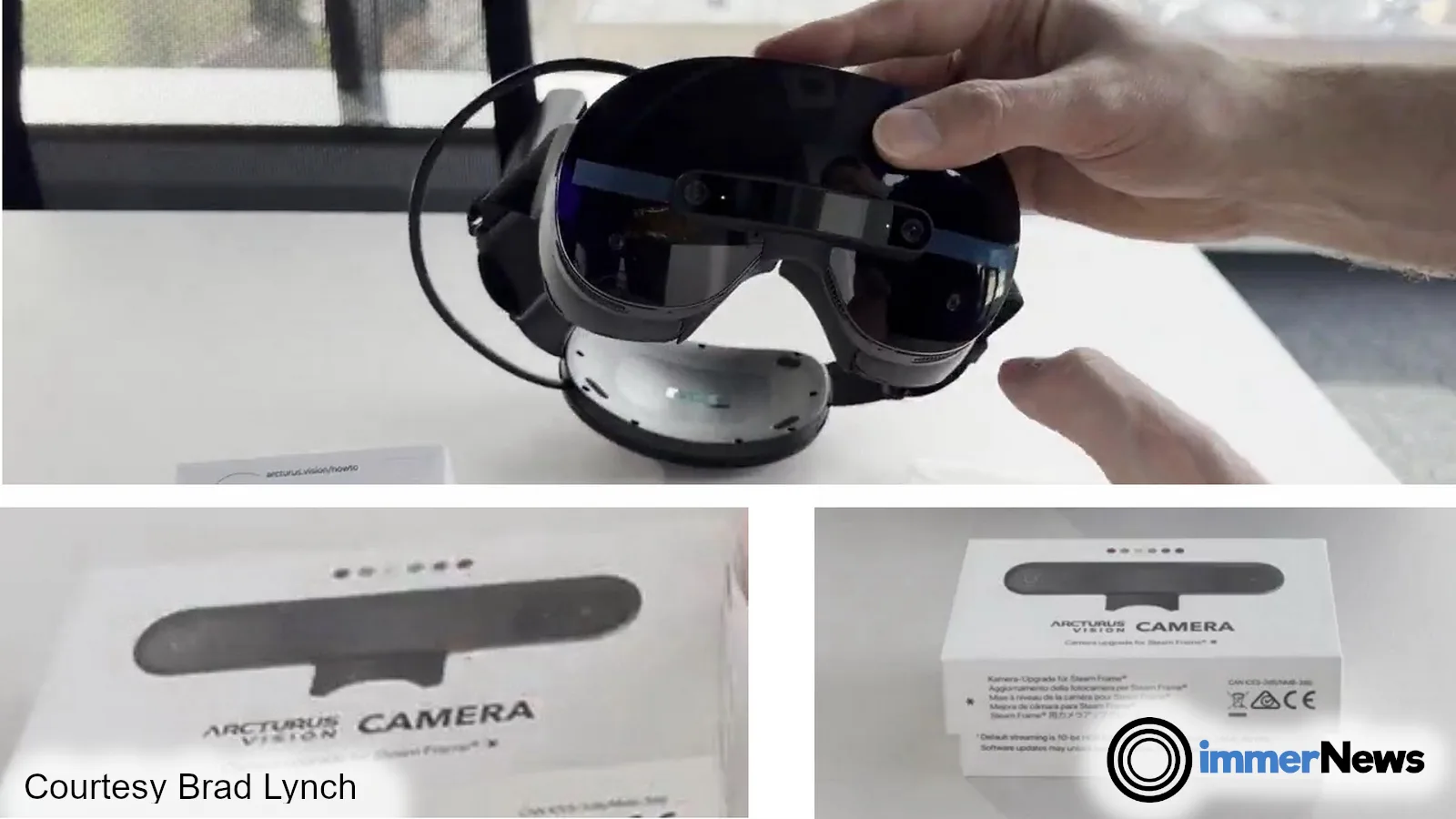

While many VR fans are awaiting the release of Valve’s upcoming headset Steam Frame, to be released soon™, new information was revealed by Brad Lynch (@SadlyItsBradley on X): A preview website at Komodo Station revealed an upcoming add-on for Steam Frame which adds cameras in front of the device: The Arcturus Vision Camera. This changes Steam Frame’s grayscale passthrough, often seen as a limitation compared with Quest 3, to full-color passthrough.
A comparison of spatial video recording across VR headsets:
| Steam Frame + Arcturus Vision Camera | Apple Vision Pro | Meta Quest 3 / 3S | PICO 4 Ultra | |
| Resolution (per eye) | 2464 × 2464 or 1232 × 1232 | 2200 × 2200 | 1280 × 1280 | 2048 × 1536 |
| Frame rate | 60 fps or 120 fps at lower res | 30 fps | up to 60 fps API stream | 60 fps |
| Field of View | 125° × 105° binocular (immerNews estimate: 105° horizontal per eye) | ~72° horizontal per eye | ~73° horizontal per eye | ~76° horizontal per eye |
| Bit depth | 8-bit SDR or 10-bit HDR (HLG) | 8-bit SDR | 8-bit SDR | 8-bit SDR |
Source: based on Komodo Station screenshots shown by Brad Lynch
The new camera module has the highest spatial video pixel count in this comparison and even offers a 120 fps option at lower resolution. In one of the website screenshots, it is mentioned that a 72 fps mode is available with a special configuration and that 144 fps can be supported with updated software. The relationship between the 72/120/144 modes and the resolution is not yet clear. The material also mentions that the vertical FOV could increase from 105° to as much as 125° with future software updates. In addition to real-time environment mapping and Gaussian Splatting support with tools, spatial video recording is mentioned by Brad Lynch as one of the applications of this camera module. For recording 3D videos on the headset, we hope Arcturus will also consider a 90 fps mode. 90 Hz has been an important target in VR for a long time: already at Oculus Connect 2014, Oculus listed 90 Hz+ among the ingredients for achieving presence. Many modern VR headsets support 90 Hz, so a 90 fps recording can map one video frame cleanly to each display refresh. Apple also uses 90 fps for its current Apple Immersive Video format.
The Arcturus add-on is specified with a camera baseline, also called interaxial distance, of 64 mm. This is the distance between the optical centers of the two cameras and is close to a typical adult human interpupillary distance (IPD). The other VR headsets used as spatial cameras are also roughly in this range. A stereo-camera baseline around human eye spacing can create disparities that are closer to our natural binocular vision than cameras with a much smaller separation. However, camera spacing alone does not determine perceived depth: field of view, lens projection, image rectification, playback geometry and possible post-processing also influence the final result. A contrasting example is spatial media captured on smartphones. The iPhone 15 Pro, for example, uses only around 19.2 mm of camera separation for spatial capture. Such a narrow baseline produces considerably less stereo disparity, particularly at medium and longer distances. It can work well for nearby subjects, but without additional depth processing it cannot geometrically reproduce the same stereo depth as a camera pair spaced roughly like human eyes.
A closer inspection of the product video also reveals one small illuminated point next to each of the two cameras. These became visible only when the module was plugged into Steam Frame. The purpose has not been mentioned in the material yet, but we are interested to hear your thoughts on what it could be in our comment section.
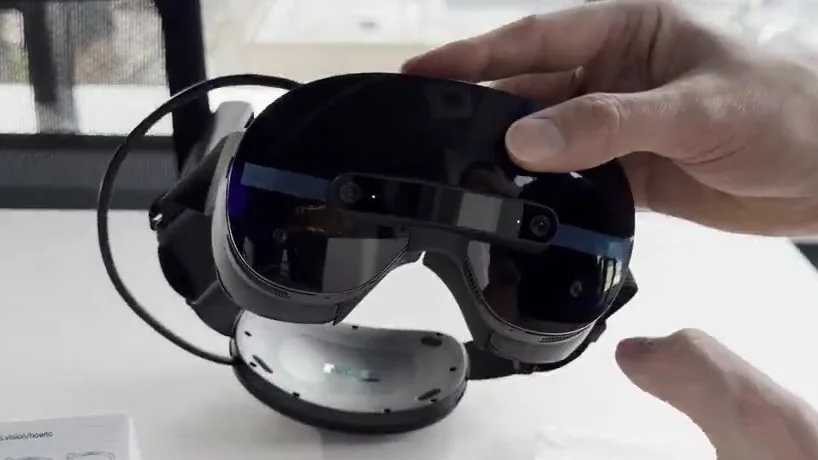
Close-up of Arcturus Vision Camera showing the two cameras and also two smaller lit spots next to them. Image: Courtesy Brad Lynch.
How about Meta’s rumored upcoming Project Phoenix?
Project Phoenix is especially interesting in this context because it is reportedly not intended to be simply another gaming-focused Quest. Current reporting describes Meta’s upcoming lightweight headset as having a strong focus on virtual screens, entertainment and immersive video. The Wall Street Journal reported that Meta has even approached companies including Disney and A24 and offered millions of dollars for immersive video productions intended to help attract users to the upcoming premium headset.
This also fits Meta’s broader strategy. At GDC 2026, Meta Director of Games Chris Pruett said that the company expects more mainstream adults to enter VR through media consumption first, with some buying a headset as a TV replacement before discovering games. Meta has also partnered with James Cameron’s Lightstorm Vision to bring significantly more 3D entertainment to Horizon OS.
In a July Instagram AMA, Meta CTO Andrew Bosworth said the company is building multiple next-generation headsets and told viewers to “stay tuned for Connect.” He did not name Project Phoenix, but the timing raises expectations that we may learn more about Meta’s future VR hardware at the event. Phoenix appears especially relevant to immersive media consumption, but the open question for us is whether Meta will also improve the creation side. As a passthrough-based headset, it will necessarily use outward-facing cameras. Their specifications and developer access remain unknown, but Meta’s camera stack has evolved considerably since Quest 3 launched, as the following history shows:
- October 2023: Release of Meta Quest 3. No app for capturing 3D photos or videos. No developer API for camera access.
- November 2023: immerGallery 1.2.2 introduced Quest 3 3D photo and video capture. To our knowledge, this was the first Quest app offering this type of guided 3D capture beyond Meta’s general headset recording. Without a camera API, however, it required Developer Mode, special ADB settings and Meta’s stereoscopic system recording. The resulting recording reached 1920 × 1920 per eye at 30 fps, still above today’s developer API resolution. We added an electronic level to help avoid uncomfortable head roll, but because it became part of the recording it had to be hidden before capture. Initially, 3D photos then had to be extracted manually from the recorded video on a computer.
- December 2023: immerGallery 1.2.3 automated the process. The electronic level alternated between visible and hidden. The app later searched in post-processing through the recording for moments after the headset had been properly levelled and automatically extracted those frames as 3D photos.
- August 2024: immerGallery 1.2.8 used Meta’s new Boundary Visibility functionality. With that, users could walk larger distances while recording without the guardian / boundary visuals interfering. This is shown in the YouTube video below.
- March 2025: With Meta XR Core SDK v74, Meta released the Passthrough Camera API as a Public Experimental feature, finally giving developers direct access to the forward-facing RGB cameras of Quest 3 and Quest 3S.
- April 30, 2025: With v76, Meta promoted the Passthrough Camera API from Public Experimental to Public, meaning apps using it could be submitted to the Meta Horizon Store. Only two days later, on May 2, we released immerGallery 1.3.5 with our Easy 3D Camera for Quest 3 and Quest 3S. To our knowledge, this was the first released Quest app using Meta’s new API specifically to let users capture their own stereoscopic photos and videos.
- September 2025: At Meta Connect 2025, the company highlighted improved camera quality in Horizon OS v78, reduced latency and dual-camera support in v81, and an upcoming increase to 1280 × 1280 camera resolution.
- December 2025: That higher-resolution mode later arrived with v83 and we updated the 3D camera feature of immerGallery immediately to support 1280 × 1280 camera resolution.
- April 2026: Unity’s OpenXR Meta package, which adds Meta Quest-specific features on top of Unity’s general OpenXR support, introduced individual left/right camera capture as well as synchronized stereo pairs on both CPU and GPU with version 2.6.0-pre.1. Before, matching a left and right image meant retrieving both independent camera streams at nearly the same time. The newer API instead explicitly tries to match the images by their capture timestamps, making properly synchronized stereo capture considerably more reliable.
- August 2026: With Unity OpenXR Meta 2.6.1, performance has improved by around 30% when converting acquired CPU camera images from YUV to RGBA32 on Meta Quest. Background: Camera sensors often provide their frames in YUV 4:2:0 formats, where brightness information and color information are stored separately and the color channels use lower spatial resolution. However, for displaying them inside an app or for image analysis, it might be useful to convert them to RGB (red/green/blue) or RGBA (…/alpha) formats.
The boundaryless camera mode on Quest 3 in action to capture content without guardian warnings
So just a few weeks before Meta Connect 2026, this is another indication that Meta and Unity continue to optimize the camera-processing stack available to Quest developers. A roughly 30% faster CPU conversion is already useful on Quest 3 and 3S and would become increasingly valuable if future devices expose higher-resolution or otherwise more demanding camera streams.
Interestingly, camera processing is not the only change in Unity OpenXR Meta 2.6.1 that could become relevant to a future media-focused headset. The update also makes Meta’s existing per-eye gaze tracking much easier for Unity developers to access. The underlying OpenXR extension dates back to Meta Quest Pro, while Quest 3 and Quest 3S lack eye tracking. Project Phoenix, on the other hand, is strongly expected to bring it back and reportedly use gaze-and-pinch as a primary input method.
Eye tracking can also benefit immersive media. With 360° video, head tracking already allows streaming systems to prioritize the currently visible part of the sphere. Gaze-adaptive streaming can go further by keeping maximum quality around where the user actually looks while reducing detail toward the peripheral vision, an approach already demonstrated in research for 360° video.
I also worked on this topic during my time at Intel. In our 2017 Best Paper Award paper “The Next Generation of In-home Streaming: Light Fields, 5K, 10 GbE, and Foveated Compression,” we used eye tracking to keep the gaze region at full resolution while reducing resolution elsewhere, cutting the required data rate by more than half. Steam Frame now uses a related concept for its Foveated Streaming: VR games and applications are rendered on a PC, but encoding quality is concentrated around the user’s gaze before the images are streamed to the headset. Meta’s new Social Eye Gaze feature is not the same low-latency gaze path used for foveated streaming, but it shows eye-tracking support becoming relevant in Meta’s developer ecosystem again.
As of September 2026, Meta does not provide its own consumer camera mode for saving clean stereoscopic photos or videos directly from the two RGB cameras of Quest 3 or 3S. Quest can of course capture screenshots and videos of the composited headset view, including apps and passthrough, but this is different from using its two physical cameras as a dedicated spatial camera. Apple Vision Pro, PICO 4 Ultra and Samsung Galaxy XR already provide their own software for capturing stereoscopic content. As long as the developer APIs remain available, third-party applications such as immerGallery can fill that gap and potentially offer functionality beyond a basic camera app.
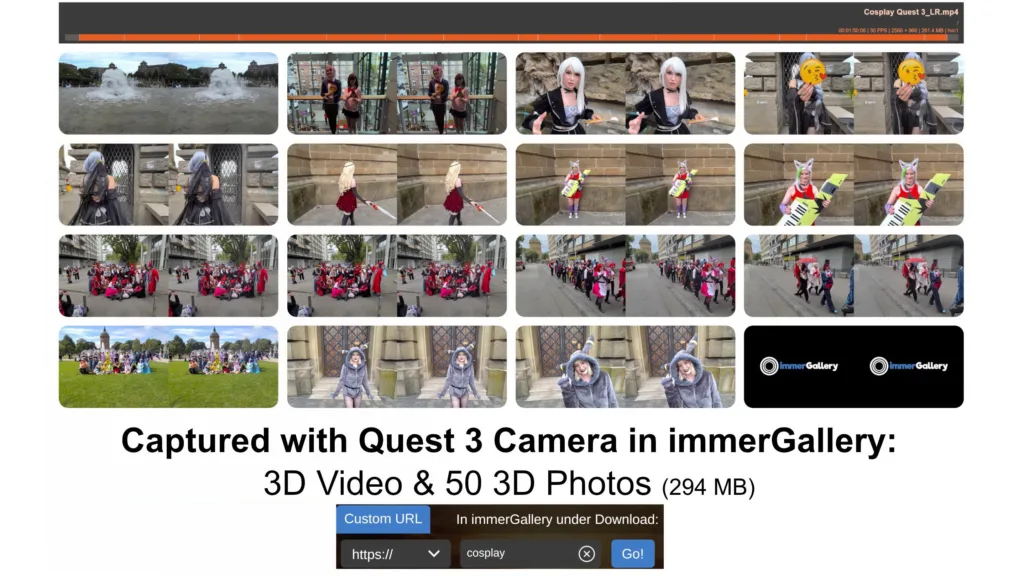
Samples Quest 3 Spatial Photos and Videos
If you are interested in how spatial photos and videos captured with the Quest 3 headset look, you can freely download our sample cosplay gallery with 50 3D photos and one 3D video captured with the immerGallery 3D Camera feature in boundaryless mode.
You can either directly download the Quest 3 3D sample content (294 MB) or use the fast path in immerGallery: Go to Downloads, Custom URL and enter “cosplay” into the input field, then press “Go!”.
How serious are VR headsets as Spatial Cameras?
More people may have a smartphone with basic stereoscopic capture functionality than they realize, but fewer of them may also own a VR headset to watch such media at reasonably high resolution. However, every owner of a VR headset that can be used as a Spatial Camera already owns the right display device for it. And even better: wearing the device while capturing the content gives an ideal preview of how the final result will look in 3D, something that dedicated 3D cameras lack. The exceptions are a few models with autostereoscopic screens, but these lose brightness and display resolution and cannot fully reproduce the depth experience. However, one practical limitation remains the form factor itself: using a VR headset as a camera in public is still unusual and likely to attract plenty of attention.
The Quest 3 / 3S developer API now supports 1280 × 1280 pixels per eye, while 1280 × 960 remains a useful 4:3 alternative. The square mode captures additional vertical field of view, while the 4:3 format can be preferable when the resulting stereoscopic content is intended to be shown on a wider virtual cinema screen. This has been a nice starter experience where users who have never owned a 3D camera can reuse their existing headset and experiment with capturing their own 3D media. However, it quickly becomes obvious that at such a low resolution important detail is lost. But this might be the point where someone interested in this area will move to a dedicated 3D camera.
At 2464 × 2464 pixels per eye, the Arcturus Vision Camera would record about 3.7 times as many pixels per view as Quest 3 at 1280 × 1280. However, that does not mean 3.7 times more visible detail. Arcturus spreads those pixels over a much wider field of view. Based on the stated 125° × 105° binocular FOV, we estimate around 105° horizontally per camera, compared with roughly 73° for Quest. This increases horizontal angular resolution from about 17.5 pixels per degree on Quest 3 to about 23.5 pixels per degree on Arcturus, an improvement of around 34%. Much of the additional pixel count is therefore used to provide a considerably wider view rather than simply increasing sharpness. For viewing this immersively in VR, having a wide cinema screen that covers roughly the horizontal field of the headset can work very well and also hides a potential issue of 3D content in the outer peripheral vision: because of the different camera positions, the left eye view will have content on its left side that the right eye view does not have and vice versa. While alignment in post-processing can mitigate that to some degree, keeping this issue far into the peripheral vision usually helps preserve immersion.
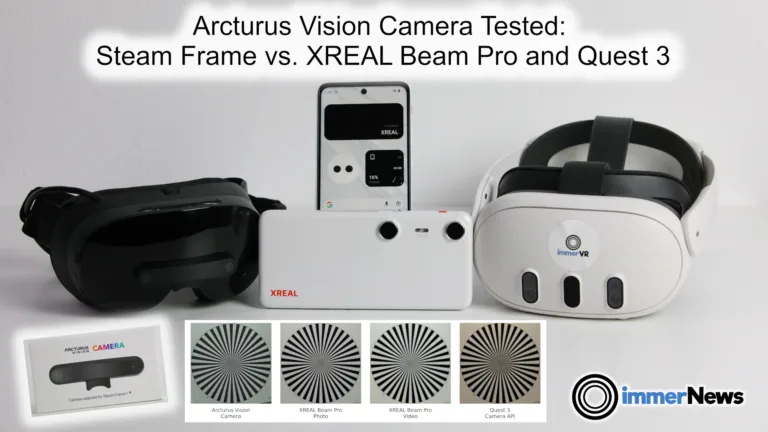
For comparison, dedicated 3D cameras can still provide higher photo resolution. XREAL Beam Pro captures up to 3840 × 2880 per eye for photos, while Acer SpatialLabs Eyes Camera reaches 3840 × 2160 per eye. Their high-frame-rate video modes have less of an advantage, or even fall behind the announced Arcturus specifications, as the comparison below shows.
To make camera resolutions with very different fields of view easier to compare, we also calculated the approximate number of horizontal pixels available per degree of captured view.
| Camera / mode | Resolution per eye | FPS | H-FOV per eye | Approx. horizontal px/° |
| Quest 3 / 3S | 1280 × 1280 | up to 60 fps API stream | ~73° | 17.5 |
| Arcturus 5K video | 2464 × 2464 | 60 fps | ~105°* | 23.5 |
| Arcturus 2.5K video | 1232 × 1232 | 120 fps | ~105°* | 11.7 |
| PICO 4 Ultra video | 2048 × 1536 | 60 fps | ~76° | 26.8 |
| Apple Vision Pro video | 2200 × 2200 | 30 fps | ~72° | 30.7 |
| Apple Vision Pro photo** | 2560 × 2560 | – | ~72° | ~35.8 |
| XREAL Beam Pro video | 1920 × 1080 | 60 fps | ~86°* | 22.3 |
| XREAL Beam Pro photo | 3840 × 2880 | – | ~86°* | 44.7 |
| Acer SpatialLabs Eyes video | 1920 × 1080 | 60 fps | 80° | 24.0 |
| Acer SpatialLabs Eyes video | 3840 × 2160 | 30 fps | 80° | 48.0 |
| Acer SpatialLabs Eyes photo | 3840 × 2160 | – | 80° | 48.0 |
Comparison of spatial-camera resolution and horizontal angular detail
* Arcturus ~105° H-FOV per eye is estimated from the advertised 125° × 105° binocular FOV. XREAL Beam Pro ~86° H-FOV is based on our testing, not an official specification.
** Vision Pro photo resolution was measured from a file we inspected; px/° assumes the spatial-video H-FOV of ~72°, as photo FOV is not published.
Pixels per degree is useful for comparing spatial sampling density, but it does not by itself determine image quality. Sensor quality, optics, image processing, noise, dynamic range, compression and other factors also matter.
For still photos, dedicated stereo cameras such as XREAL Beam Pro and Acer SpatialLabs Eyes Camera still capture noticeably more angular detail than the current headset cameras. For video, however, the situation is already becoming different. The Arcturus Vision Camera’s announced 2464 × 2464 per-eye mode at 60 fps would exceed the 60 fps video resolution of both XREAL Beam Pro and Acer SpatialLabs Eyes Camera, which record 1920 × 1080 per eye at that frame rate. Acer can record 3840 × 2160 per eye, but only at 30 fps. Headset-mounted spatial cameras could therefore already become competitive with, or even surpass, some dedicated 3D cameras released in recent years when high-frame-rate video is the priority.
immerGallery on Steam Frame with Arcturus Vision Camera?
immerGallery for Windows is already available on Steam, and Valve officially supports Android APKs on Steam Frame through its Lepton compatibility system. We would therefore like to submit an Android-based version of immerGallery to Steam in the future.
We will also try to obtain an Arcturus Vision Camera. If its developer APIs provide the necessary access to the stereo camera streams, we would be interested in supporting it with immerGallery’s 3D Camera functionality, including features such as our electronic level for capturing clean stereoscopic photos and videos.
Conclusion
VR headsets are increasingly becoming not only devices for viewing immersive media, but also practical tools for creating it. Quest 3 showed what was possible even with limited camera access, while Steam Frame with the Arcturus Vision Camera could push headset-based spatial capture considerably further. Whether Meta follows the same direction with Project Phoenix is one of the more interesting questions for its next generation of VR hardware, and Meta Connect 2026 may soon give us the first hints.
Links
- Brad Lynch, X: Post 1 about Arcturus Vision Camera
- Brad Lynch, X: Post 2 about Arcturus Vision Camera
- Reddit Post on r/SteamFrame with screenshots of Komodo Station website about Arcturus Vision Camera
- Arcturus Vision Camera: placeholder website with newsletter signup
- Steam Frame
- Meta Connect 2026
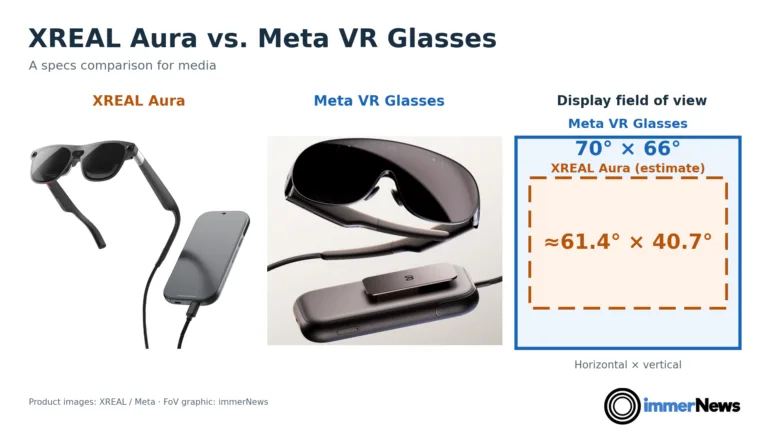
Go figure, a third party company was able to solve the arguably biggest design limitation in SteamFrame hardware (monochrome pass-through video) … and it did before that headset was even released.
And as a bonus, with that dual camera module, we will get a spatial video recording support. This most likely will be one of the easiest, and hopefully affordable, ways to start exploring a true 3D content recording (no need to buy expensive Samsung or Apple phone, which uses two different focal length cameras kludge and creates mismatched Left and Right stereoscopic views).
At least for Steam Frame users, it will hopefully be easy to just get the Arcturus Vision Camera and use it for 3D/stereo capturing. It will be interesting to see at which price it will be sold. While the integrated 3D camera in Quest 3 is rather low-resolution, it does come with the initial headset price.
Valve could have easily included this feature set into the Frame if they were willing to up the price by $200, but most users don’t need these features, so they went for the affordability option.