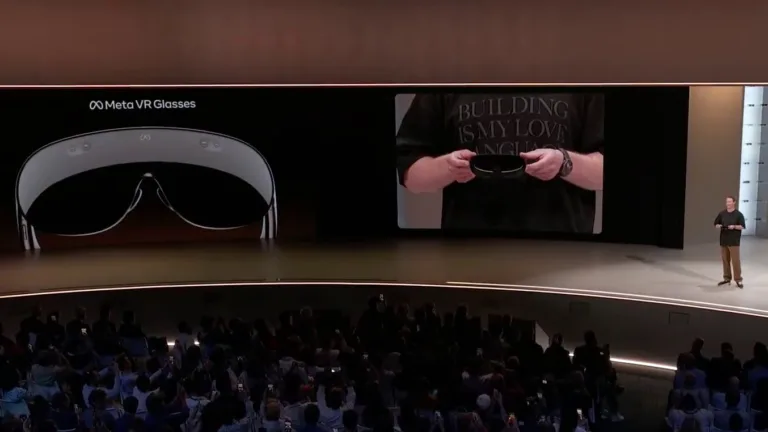

XREAL has announced the prices of its Aura glasses: $1,279 for the base model and $1,499 for the model with more RAM and storage. This puts Aura close to Meta VR Glasses at $1,299. For us at immerNews, the interesting question is which of these lightweight devices looks more promising for movies, 3D photos and immersive media.
This is a comparison based on announced and reported specifications. Neither device has shipped yet, and we have not tested them. We draw on our experience developing our VR media player app immerGallery and on the expectations discussed in our earlier Meta VR Glasses article.
Two Aura models, but Europe is on the waitlist
Aura comes with 12 GB RAM and 256 GB storage for $1,279, or 16 GB RAM and 512 GB storage for $1,499 (USD).
XREAL says shipping will begin before the holidays in the US, Canada, Japan and South Korea. Sadly, Europe is not part of this initial 2026 launch and a specific date is still not displayed in the XREAL EU Shop. That is disappointing for people who hoped to get the glasses this year, as priority passes for earlier access to the device were also sold in Europe in June 2026. The Meta VR Glasses are announced for spring 2027.
Existing paid XREAL Aura reservation holders in the initial launch countries can now complete their purchase. Founder Priority Pass holders who complete payment and configuration by October 17 will also receive an individually numbered Founder’s Edition.
XREAL Aura vs. Meta VR Glasses: the specs
| Specification | XREAL Aura | Meta VR Glasses |
|---|---|---|
| US price | $1,279 / $1,499 | $1,299 |
| Form factor | Glasses + compute puck | Glasses + compute puck |
| Weight on the head | About 95 g, excluding puck | About 100 g, excluding puck |
| Display type | Sony micro-OLED | Micro-OLED |
| Pixels per eye | 1920 × 1200 | 2412 × 2288 |
| Refresh rate | Up to 120 Hz | Up to 120 Hz |
| Field of view | 70° diagonal (reported); ≈61.4° horizontal × 40.7° vertical (our estimate) | 70° horizontal × 66° vertical (nominal upper bound) |
| Angular resolution | 32 PPD | 37 PPD |
| HDR formats | Unconfirmed | Dolby Vision, HDR10, HLG |
| Chipset | Snapdragon Reality Elite (XR2 Gen 3) + XREAL X1S | Snapdragon Reality Elite (XR2 Gen 3) |
| RAM / internal storage | 12 GB / 256 GB or 16 GB / 512 GB | 12 GB / 128 GB; storage reported |
| microSD | Unconfirmed | Yes; up to 1 TB reported |
| Operating system | Android XR | Meta Horizon OS |
| View of the real world | Optical see-through with electrochromic dimming | Colour camera passthrough, 26 PPD; open periphery |
| Hand tracking | Yes | Yes |
| Eye tracking | No, per hands-on reporting | Yes |
| Tracked controllers | No 6DoF controllers announced; Bluetooth gamepads supported | Optional Touch Plus controllers; sold separately |
| IPD fit | M: 60–66 mm; L: 66–72 mm | 56–70 mm; manual, per-eye adjustment |
| Native DisplayPort input | Yes, on puck | Yes, on puck |
| Media battery life | Unconfirmed in published specifications | Up to about 3 hours, claimed |
| Initial shipping | Before the holidays in 2026, in four launch countries | Spring 2027 |
Aura lets you see the physical world directly
Aura’s transparent optics are, in our opinion, its strongest argument. You see your surroundings directly through the lenses. Meta also lets you remain aware of the room, but the view within its display area comes from cameras. Only its open sides provide a direct peripheral view.
You can still see through Aura’s lenses when it is switched off. However, an early PCMag hands-on also reported distortion of the outside view through the prism lenses. Therefore, this would not be perceived like looking through ordinary glasses. Meta’s central display area remains opaque without power.
Aura’s electrochromic dimming can reduce incoming light when you want to concentrate on a movie. Whether you prefer this combination of a virtual screen and a direct physical view of the room could be one of the most important factors when choosing between the two devices.
Field of view for movies, photos and VR180
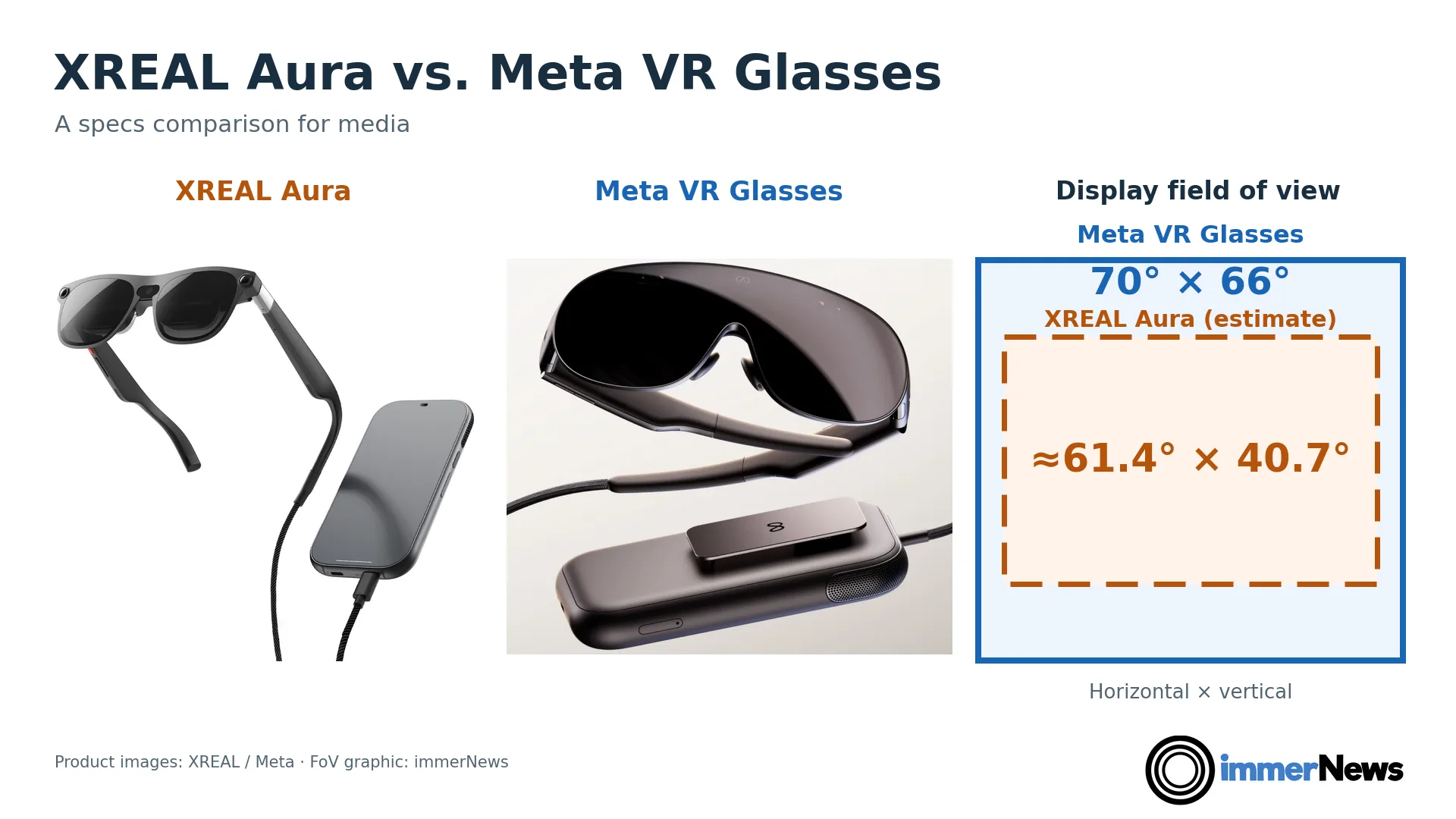
Meta specifies a nominal straight-ahead field of view of 70° horizontally and 66° vertically for Meta VR Glasses. This is an upper bound; the visible area can be smaller depending on fit, eye position and gaze direction. XREAL advertises a 70° field of view for Aura, which The Ghost Howls and Tom’s Guide describe as diagonal.
Using Aura’s reported diagonal FoV and its 16:10 display proportions, we calculate approximately 61.4° horizontally and 40.7° vertically, assuming rectilinear optics. These are not confirmed specs from XREAL. Based on this comparison, Meta should offer a wider view, with a particularly large difference vertically.
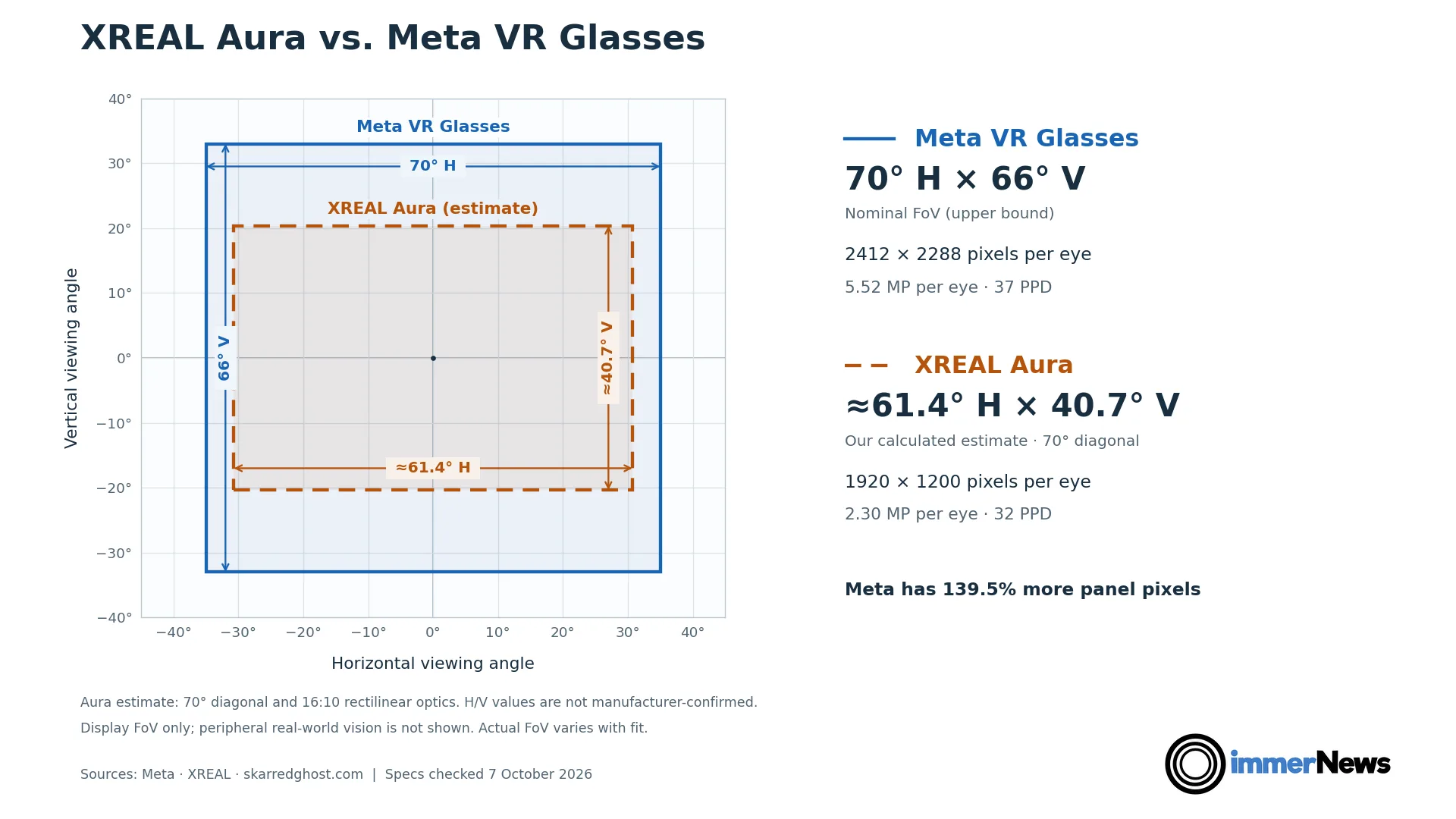
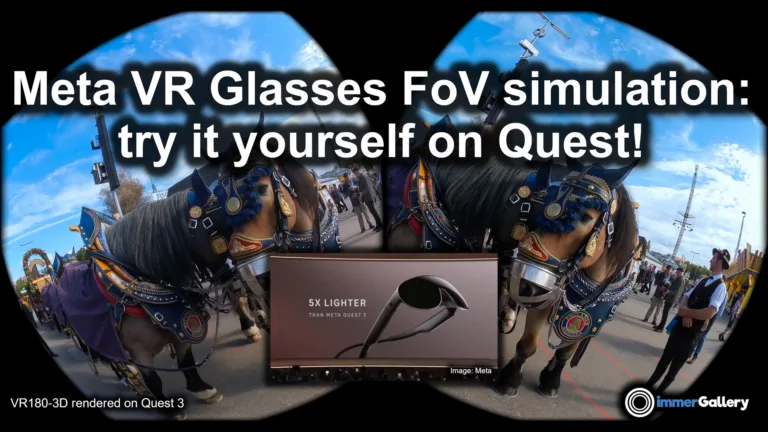
As discussed in our earlier article “Meta VR Glasses: better for 3D movies, but less immersive for VR180?”, regular 2D and 3D movies can work well within a smaller FoV. Wide panoramas, VR180 and 360° content depend more on the feeling that the scene surrounds you. In our Meta VR Glasses FoV simulation on Quest, regular movies on flat or curved cinema screens remained enjoyable, while spherical media lost much of that feeling of presence for us.
Based on the viewing angles, we would expect Aura’s more limited vertical view to make that effect stronger. The Meta VR Glasses should leave more room for looking around a scene or making small head movements while keeping the virtual movie screen fully visible.
Why higher PPD matters for 4K movies
Meta has about 139.5% more panel pixels per eye than Aura. Its advertised angular resolution is also higher: 37 PPD compared with 32 PPD.
From developing immerGallery, we have seen that Quest 3, with its advertised 25 PPD, can already benefit noticeably from moving from 1920 × 1080 to 3840 × 2160 movies. At the cinema screen sizes we normally use, 1080p does not show all the detail the headset can deliver. With 4K providing four times as many source pixels, we expect the headset’s display and optics to become a more important limiting factor.
Based on this experience, we would expect 37 PPD to offer an advantage over 32 PPD with detailed 4K movies. The virtual screen’s size and distance also matter: a smaller or more distant screen uses fewer headset display pixels, while a larger or closer screen spreads the content of the video across more display pixels.
HDR and taller IMAX movies
Meta lists Dolby Vision, HDR10 and HLG support and has announced IMAX Enhanced certification and Disney+ support. HDR playback still depends on the app and content. Disney+ already offers 3D HDR movies on Vision Pro, including Avatar: The Way of Water, but there have been no confirmed HDR titles from Meta’s side yet. Also for users enjoying offline media, HDR content can be found for example on the 4K Ultra HD Blu-ray of Spider-Man: Into the Spider-Verse.
Disney+’s commonly used expanded IMAX format is 1.90:1. It is taller than a 2.39:1 widescreen movie but still fits within Aura’s 16:10 display shape. The rarer 1.43:1 format that IMAX sometimes uses is more demanding vertically. One example is the 2021 remastered 4K UHD Blu-ray of Batman v Superman: Dawn of Justice (Ultimate Edition), which preserves that ratio for its IMAX sequences.
Aura could of course also display the complete 1.43:1 image, but its vertical FoV would restrict how large the virtual screen could be before the top and bottom areas leave the view. With the Meta VR Glasses, there should be more room available for this. However, this is a special case, as most movies use wider formats.
Internal storage versus swappable movie collections
Aura’s 256 or 512 GB of internal storage is welcome, compared with Meta’s reported 128 GB. The operating system and apps consume part of that space, which can become increasingly tight over time.
However, for media files, the Meta VR Glasses have been reported to support microSD cards up to 1 TB. A large movie collection could be stored on such a card, and users could swap between several cards. Aura therefore has the advantage in built-in capacity, while Meta could be more flexible for large offline collections. Whether Meta also allows apps on microSD cards is not known yet.
Apps, hand tracking and optional controllers
Aura’s Google Play access should make installing familiar Android apps convenient. Horizon OS also runs Android apps, including through sideloading, but this involves more effort and does not guarantee that every APK will work. Existing Quest users may also value keeping their current app and game library.
Meta’s optional tracked controllers can be useful beyond games: From our experience with the file explorer introduced in immerGallery 1.4.4, selecting files, marking several items, cutting and pasting, and navigating menus can be faster and more precise with real controllers. Also, the physical buttons and hover vibrations over UI elements give useful haptic feedback.
For simply choosing a movie or pausing playback, hand tracking can be convenient. All immerGallery features already support hand tracking on Quest 3 and 3S, so having both input options is welcome.
The compute puck of XREAL Aura also doubles as a touchpad. Similar to a laptop touchpad, it provides mouse-like input for moving a cursor and selecting items. This could be useful for selecting files and navigating menus without relying on hand tracking, although we would need to test how well it works for more complex operations.
Could either device also become a spatial camera?
Quest 3 already shows how a headset can be used to capture stereoscopic media, as we covered in our article on spatial cameras in VR. Similar possibilities on Meta VR Glasses seem plausible, but have not been confirmed.
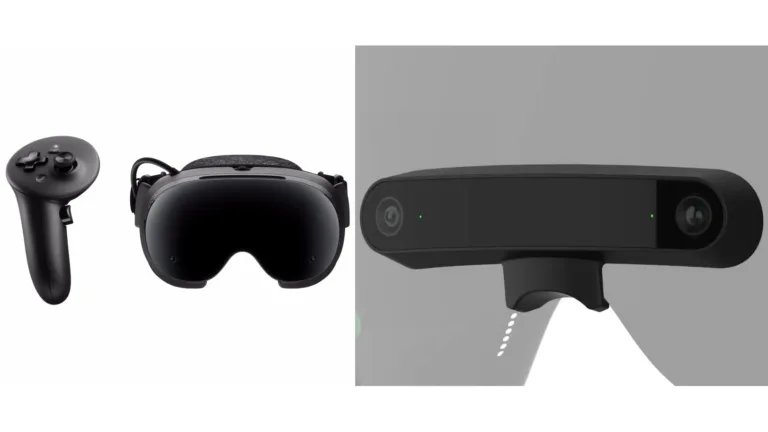
Aura also has cameras. XREAL lists two world-facing tracking cameras and one separate high-resolution camera with a privacy indicator. It is unclear if the two tracking cameras could also be used as a 3D camera. Tracking cameras are sometimes grayscale only, and it is not yet clear whether that is the case here. Recording stereoscopic media would also require access to suitably synchronized camera feeds, which has not been confirmed.
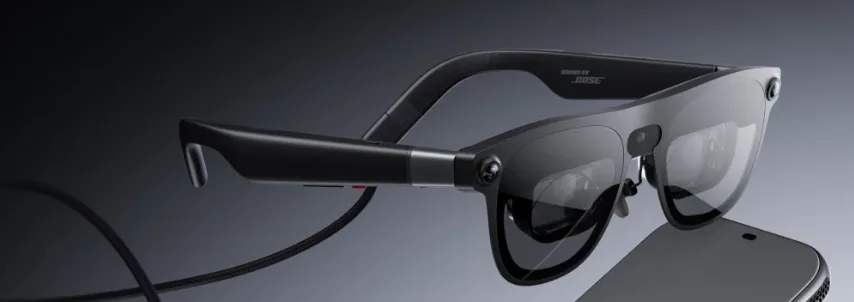
The outer cameras appear more widely separated than a typical adult’s eyes. If used as a stereo pair, a wider camera spacing would increase the differences between the two views, especially for nearby subjects, and could exaggerate perceived depth.
Even though the XREAL Beam Pro puck, with its two built-in cameras, turned out to be a very good 3D camera at a low price, it currently seems less likely to us that the Aura glasses themselves will offer a similar spatial capture feature.
Our expectation for media consumption
Based on the specifications, we currently lean towards Meta VR Glasses for a device mainly used for media consumption. The display resolution, larger FoV, HDR support and expandable storage make a convincing combination on paper.
Aura’s strongest argument is its transparent optics. If seeing the physical environment directly is particularly important to you, that could outweigh the other differences. Google Play access, more internal storage and earlier availability in the launch countries may also be a decisive factor.
We are looking forward to trying both devices in the future to judge their actual image quality and comfort.
What is your impression of XREAL Aura compared with Meta VR Glasses, based on the specs and our analysis of what these differences could mean for media? Let us know in the comments!